V Series 2019 Specs, Features, and Value: Is it worth the price tag?
The V Series 2019 arrived as Vizio's answer to the budget 4K TV market: a lineup intended for buyers who want UHD resolution, basic HDR handling, and a familiar smart platform without the premium price of flagship models. This article analyzes what the V Series 2019 delivers in real-world usage, examines the features that matter to typical buyers, compares it to contemporaries in the same price band, and offers a practical buying guide to help decide whether the V Series 2019 is the right choice.
Introduction: who the V Series 2019 is for
The V Series 2019 is targeted at value-conscious consumers furnishing living rooms, bedrooms, or secondary entertainment areas who prioritize image clarity and smart streaming over top-tier HDR performance or advanced gaming features. It suits people who stream movies and shows, watch sports, and play console games casually. For shoppers upgrading from 1080p sets or buying their first 4K TV, the V Series 2019 promises a noticeable step up at a lower cost than midrange and premium models.
Overview of key specifications
At its core, the V Series 2019 is a family of LED-backlit TVs with 3840 × 2160 resolution. The models in the line vary by size, generally covering common consumer sizes such as 43", 50", 55", 65", and larger variants, with panel and backlight design optimized for cost efficiency. Typical capabilities include:
- 4K UHD resolution (3840 × 2160) for sharper detail compared with 1080p sets.
- Basic HDR support, commonly HDR10 and HLG playback for improved contrast and color from compatible content.
- SmartCast platform that supports built-in casting, popular streaming apps, and a mobile-app remote experience.
- 60 Hz native refresh rate, which handles typical movie and TV content smoothly but is not optimized for high-frame-rate gaming or motion clarity demanded by some enthusiasts.
- Multiple HDMI ports, Ethernet and Wi‑Fi connectivity, and optical audio out for integration with soundbars or home audio systems.
Note: Individual features and port counts can vary by model and screen size. Buyers should review the exact model number for precise connectivity and physical dimensions before purchase.
Detailed product review and real-world performance
Picture quality
The V Series 2019 delivers a clear improvement over older 1080p TVs thanks to its native 4K panel and upscaling engine. For everyday viewing—streaming series, broadcast TV, and UHD movies—it reproduces fine detail in stills and static shots reasonably well. Color reproduction is generally pleasing out of the box for casual viewers, and the set benefits from simple picture presets that boost saturation for a more vivid look in living-room environments.
Where the V Series shows its budget lineage is in HDR and contrast performance. The set supports popular HDR formats that many streaming services use, which improves highlights and color depth compared with SDR content. However, peak brightness and local contrast control are modest compared to midrange and premium models. This means that high-contrast HDR scenes will exhibit less punch in highlights and shallower shadow detail in dark rooms. For buyers who watch a lot of HDR movies in a dim home theater, the V Series will not match the dynamic range of higher-tier TVs, but in typical living-room lighting it still offers a noticeable enhancement over SDR content.
Viewing angles and uniformity
LED panels at this price point tend to be optimized for direct viewing. The V Series 2019 performs best when viewers sit near the center axis; brightness and color shift at wider off-axis angles are noticeable. For families who arrange seating directly in front of the TV, this is usually acceptable. Panel uniformity—how evenly the screen backlight illuminates the panel—can vary by unit and size. Some buyers report minor clouding or uneven backlight in very dark scenes, a common trait in entry-level LED sets.
Motion handling and gaming
Motion for standard content such as movies and TV shows is generally adequate. The 60 Hz native refresh and built-in processing handle typical broadcast and streaming frame rates without introducing severe artifacts. There is often an optional motion-smoothing feature, which can reduce judder on some material but may introduce the “soap opera” effect that some viewers dislike.
For gaming, the V Series 2019 can be a good match for casual and family gaming. Input lag on recent budget 4K TVs is often low enough to offer a responsive experience on consoles like the PlayStation and Xbox for most players. Competitive gamers seeking the lowest possible latency, high refresh rates (120 Hz), or advanced gaming features such as variable refresh rate (VRR) and auto low-latency mode (ALLM) will likely prefer higher-tier models. The V Series is not positioned as a gamer-first TV, but it is serviceable for multiplayer and single-player console play.
Smart platform and apps
Vizio's SmartCast platform is focused on simplicity. It supports a range of streaming apps and integrates casting functionality for mobile devices, making it straightforward to send content from phones and tablets. The platform evolves via firmware updates, and the mobile app provides a convenient virtual remote and input selection. Power users who require a very large native app library or advanced voice assistant integrations may find SmartCast less expansive than some competitors, but for mainstream streaming services the platform covers the essentials.
Sound and external audio
Onboard speakers in the V Series 2019 are adequate for general TV watching—dialogue is clear at moderate volumes and typical TV shows and newscasts sound natural enough. For movies, music, and immersive gaming, the thin cabinet design limits bass and overall sonic depth. Most buyers aiming for a fuller audio experience will pair the TV with a soundbar or external speaker system. The TV provides common audio outputs such as optical audio and HDMI ARC/eARC (implementation varies by model), which simplifies connectivity to external audio gear.
Find top-rated TVs & Home Theater products at great prices.
Shop Amazon →Design and build
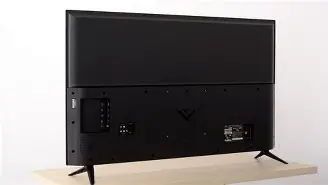
Design is utilitarian and consistent with the class: thin bezels on three sides, a slightly thicker bottom bezel bearing the brand mark, and a stable stand suitable for typical media consoles. Build quality is solid for the price; the chassis and finish are unremarkable but practical. Wall mounting is supported via standard VESA patterns on compatible sizes.
Pros & Cons
- Pros:
- Attractive price-to-performance ratio for 4K streaming and everyday TV.
- Native 4K resolution with usable HDR support for brighter content.
- SmartCast simplifies streaming and built-in casting from mobile devices.
- Multiple size options suit a wide range of rooms and budgets.
- Reasonable input lag for casual and family gaming.
- Cons:
- Limited HDR peak brightness and local dimming compared with midrange/premium TVs.
- Viewing-angle and uniformity limitations noticeable off-center or in dark rooms.
- Basic audio that benefits from an external soundbar for cinematic content.
- Not designed for high-frame-rate gaming or advanced gaming features (120 Hz/VRR).
How the V Series 2019 compares (table)
| Model/Aspect | V Series 2019 | TCL 4-Series (2019) | Samsung RU7100 (2019) |
|---|---|---|---|
| Positioning | Budget 4K, value-focused | Budget 4K with Roku platform | Entry-level 4K from major brand |
| Smart Platform | SmartCast (casting-focused) | Roku TV (wide app support) | Tizen (Samsung's app ecosystem) |
| HDR support | HDR10, HLG (basic) | HDR10, HLG (basic) | HDR10+ / HDR10 / HLG (varies by model) |
| Refresh rate | 60 Hz native | 60 Hz native | 60 Hz native (some models have motion enhancement) |
| Best for | Value buyers wanting 4K and casting | Users who prefer Roku's UI and broad channel support | Buyers favoring brand ecosystem and reliable performance |
Real-world use cases: matching the V Series 2019 to buyer needs
Understanding where the V Series 2019 fits requires thinking about typical buyer priorities and viewing environments:
Living-room streaming and TV
For households that use streaming services as their primary content source, the V Series 2019 provides clear visual improvements over older non‑4K sets. Its smart features cover the major streaming apps and its picture presets are tuned to make streaming content look lively in well-lit rooms.
Secondary TVs and bedrooms
The V Series is a solid choice for bedrooms, guest rooms, or kitchens where size, price, and ease of use matter more than advanced HDR performance. The modest footprint, uncomplicated interface, and price make it a practical secondary TV.
Casual gaming and family use
Families who play console games casually will find input responsiveness good enough for most console titles. The TV supports multiple HDMI inputs for consoles and streaming devices, making it a simple hub for family entertainment.
Home theater enthusiasts
For users building a dedicated home theater who expect deep contrast, high peak brightness for HDR, and premium motion performance, the V Series 2019 is not ideal. Enthusiasts should look at midrange or premium models with better local dimming, higher brightness, and advanced processing.
Buying guide: what to check before purchasing
When considering the V Series 2019 or any budget 4K TV, buyers should evaluate the following factors to ensure the purchase meets their needs:
1. Room lighting and viewing distance
Assess the typical viewing environment. In bright rooms, a TV with moderate brightness and anti-reflective treatments can suffice; in dark home theaters, prioritize contrast and local dimming. Choose a screen size appropriate for viewing distance—larger rooms benefit from 55" and up, while smaller spaces are well-suited to 43"–50".
2. HDR content expectations
If HDR is important, determine how much HDR content will be watched and whether peak brightness matters. The V Series improves HDR playback over SDR but does not match the dramatic highlights found on higher-tier sets. If filmmakers' HDR effects and deep black levels are a priority, consider stepping up to models with stronger local dimming and higher nits.
3. Gaming requirements
Casual gamers are well served, but competitive or fast-paced gamers should confirm input lag and check for gaming-specific features. If 4K/120Hz support, VRR, or ALLM are required, look at more recent or higher-tier offerings.
Shop the latest TVs & Home Theater picks on Amazon.
Shop Amazon →4. Smart features and app availability
Confirm that the apps a household uses are available on SmartCast or can be cast from mobile devices. Some buyers prefer Roku or other platforms for their simplicity and broader channel support; others value integrated casting. Consider which ecosystem fits the household's habits.
5. Audio and accessories
Expect to budget for a soundbar if immersive audio is desired. Verify whether the model supports HDMI ARC/eARC or only optical output, as this affects audio routing and compatibility with certain sound systems.
6. Connectivity and ports
Check the number and type of HDMI ports, presence of an Ethernet port for stable streaming, and USB ports for media playback. Ensure the TV's placement allows easy access to the ports and that the chosen size fits the mounting or stand dimensions of the room.
7. Warranty and update policy
Examine the manufacturer's warranty and look for community feedback about firmware update cadence. Budget TVs rely on occasional updates to improve app stability and platform security, so a manufacturer that provides timely updates is preferable.
Value assessment: is it worth the price tag?
Value is subjective and depends on what a buyer values most. The V Series 2019 is compelling when the priority is straightforward: maximize screen size and 4K resolution while minimizing cost. For consumers who primarily stream TV shows and movies, need a second set for casual viewing, or want a reasonably priced gaming display for family play, the V Series 2019 offers strong value.
However, buyers who place a premium on HDR performance, deep blacks, wide viewing angles, or advanced gaming features will find the V Series limited and may prefer midrange alternatives. The decision comes down to balancing budget against priorities: the V Series 2019 is worth its price for many practical use cases, but not for every specialized need.
Final thoughts and recommendation
The V Series 2019 is a pragmatic choice for buyers seeking an affordable entry into 4K TV ownership. It delivers a clean 4K picture, functional HDR support, and an easy-to-use smart platform in a package that favors price-conscious shoppers. For everyday living-room viewing, bedrooms, and casual gaming, it provides a solid experience.
Those building a dedicated home theater, or users who demand top-tier HDR, wider viewing angles, or the latest gaming features, should consider stepping up to higher-tier models. For the majority of consumers looking for a reliable, budget-friendly 4K TV in 2019's market, the V Series 2019 remains a sensible option—provided the buyer aligns expectations with the product’s design priorities.